

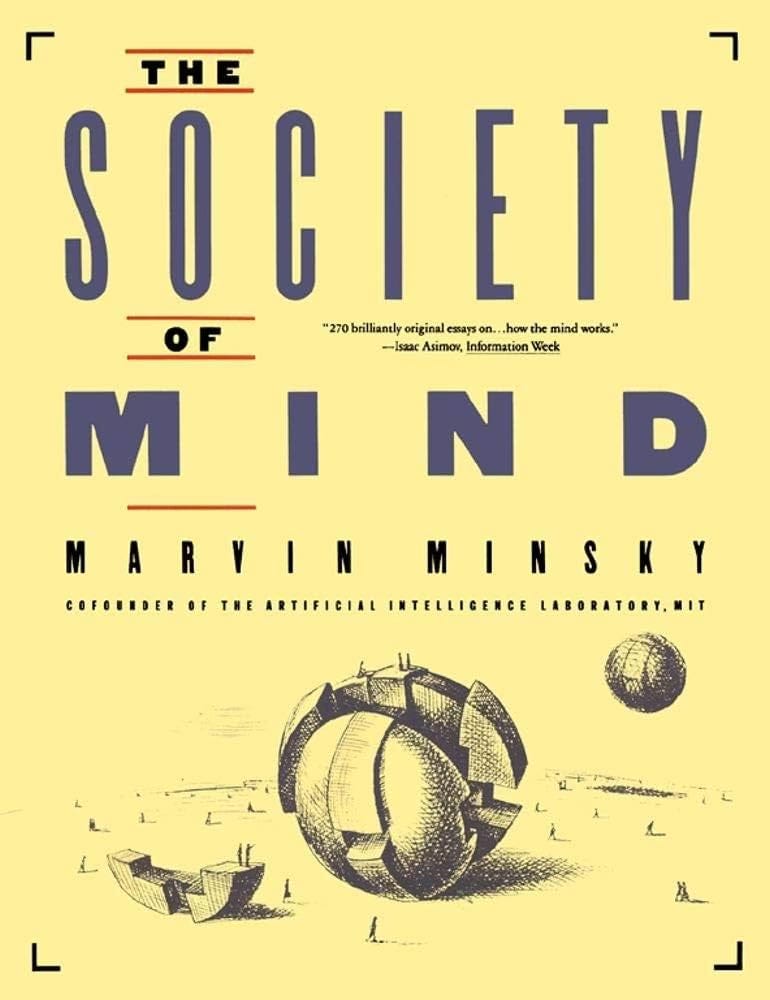
A Deep Intuition: I Want to Try Building Marvin Minsky’s Society of Mind
That day, I took my child to the playground. When it was time to leave, I began backing the car out.
I shifted into reverse, pressed the brake, and the car started moving slowly backward.
Then, all of a sudden, my mind went blank—
The brakes weren’t working.
Not a vague sense of slipping, but a very concrete judgment, almost electric in my body:
the brakes had failed, the car was still reversing, and behind me was a large drop.
In the next second, the car was going to fall.
My whole body snapped into something primitive.
My palms were sweating, my chest tightened, my breathing became shallow.
You know that kind of fear—not imagined fear, but the kind where your body has already reached a conclusion for you:
Danger is happening.
I pressed the brake harder, even wondered whether I was stepping on the wrong pedal—
but the car was still moving.
In that split second, my mind started running through emergency options:
Call my husband?
Call the police?
Call an ambulance?
Get my child out of the car?
Am I about to faint?
Later, I realized the truth was almost absurd:
My car wasn’t moving backward at all.The car next to me was moving forward.
Its motion at the edge of my vision created a powerful reference-frame illusion.
My brain’s “world model” flipped directions instantly, and I became convinced that I was accelerating backward, unable to stop.
The moment I realized this, it felt as if my brain rebooted.
My heart rate slowed. My hands stopped shaking.
But I had mild hypoglycemia that day, and after stopping the car, I was still shaken—almost faint.
I picked up my phone. What was I going to do?
In the end, I did something that sounds ridiculous, but felt very real to me:
I opened ChatGPT’s voice mode and let it talk to me slowly, calmly.
I couldn’t exactly call the police.
What Was Most Frightening Wasn’t the Illusion —
It Was the Certainty of the Illusion
Afterward, I kept thinking:
Why did that illusion feel so real?
Why, even with my foot firmly on the brake, was I subjectively certain that the brakes had failed?
Because the human brain is not a camera.
It is closer to a real-time interpreter—constantly assembling sensory inputs into “what I believe is happening right now.”
When inputs are ambiguous, reference frames unstable, and bodily conditions degraded (low blood sugar, fatigue), the brain leans heavily on fast default explanations.
And those defaults are:
Fast.Coarse.Optimized for survival.
The brain doesn’t verify first.
It pushes you into action first—because, in evolution, a false alarm is far cheaper than a missed one.
So what truly frightened me wasn’t that I almost got into an accident.
It was realizing this:
The human brain is not reliable.
But when it is unreliable, it can feel absolutely certain.
That is why I am writing about Marvin Minsky today.
Marvin Minsky: The Man Who Treated Mind as an Engineering System
Five years ago, I wouldn’t have felt anything particularly strong about The Society of Mind.
Back then, “psychological engineering” sounded like an overreach.
A computer is a computer.
A human mind is a human mind.
How could they map onto each other?
A society of mind?
Many small mechanisms forming a single self?
It sounded implausible.
But over the past year, as I’ve been building agent systems, I’ve begun to understand something:
Minsky wasn’t writing mysticism.He was writing architecture.
His view of the mind can be summarized very simply:
You are not a single, unified “self.”
You are a temporary coalition of many small, specialized, sometimes conflicting mechanisms.
That is what Society of Mind really means.
The mind is not an empire ruled by a king.
It is a society of agents competing for interpretive and behavioral control.
It may sound abstract—
But I had just lived through it.

That One Second While Reversing:
A Minsky-Style Decomposition
Let’s take the simplest possible approach and break that “brake failure” illusion into concurrent mechanisms—think of them as small workers inside the mind:
Motion-detection agent
Detects movement in peripheral vision and reports: “You are moving.”
Reference-frame agent
In a complex parking-lot environment, misattributes motion—confusing another car’s movement with my own.
Danger alarm agent
Receives the signal “reversing + drop behind” and immediately escalates the system into emergency mode.
Physiological resource monitor
Low blood sugar increases system-wide alertness and reduces precision.
Rational interpreter (late-arriving)
Shows up last and says: “Wait. It’s the other car.”
Notice the order.
Reason is not the commander.
It is the last one to write the report.
The key insight is not that I “made a mistake,” but that:
A single wrong interpretation can instantly dominate the entire system.
It can take over perception, action, decision priority—
even whether you call the police or not.
This is what Minsky wanted us to see:
The power structure of the mind can be decomposed, described, and engineered.
Five years ago, I would not have believed this.
Why I Now Admire Him So Deeply
Because I’ve realized that what I’m building is slowly growing into something he once imagined.
Five years ago, I could not have written—or justified—a system directory like this:
Persona (state / personality layer)
Policy Gate (rules and enforcement)
Event Ledger (auditable history)
Memory Store (long-term world memory)
Observability (metrics and traceability)
Next step: K-lines (experience index lines—one-click recall of an effective mental configuration)
If you’ve read my earlier writing, you know I keep emphasizing this:
In long-term systems, data is ontology.
True memory must be written in the moment, without knowing the outcome, while bearing risk.
Minsky’s idea of K-lines is almost the psychological-engineering version of the same principle.
A K-line does not store facts.
It stores configurations—which mechanisms were active together, and how they coordinated successfully.
Returning to that reversing incident:
If you treat it as a reusable configuration, the next time a similar situation occurs, you don’t have to experience another system-wide collapse.
You want faster activation of verification mechanisms.
Faster stabilization of reference frames.
Earlier voice for rational interpretation.
If you keep following my writing and my engineering work, this will matter.
Minsky’s ideas matter to me now.
I am currently exploring all of this, step by step, on top of Google ADK.
I’ll Take It Slowly — Starting from the Most Basic Vocabulary
I am still at a very early stage of exploration.
But I want to write to you honestly—not to memorialize an AI pioneer, but to treat him as a still-living engineering resource:
A way to explain the mental moments we all experience,
and to map them into structures that can be implemented, audited, and reused.
Next, I’ll start from the most basic concepts:
What is an agent (a small mental mechanism)?
What is a frame (how context summons agents)?
What is a mode (how emergency states take over)?
What is a K-line (how an effective self becomes a recallable configuration)?
And how do we move, step by step, from psychological metaphor to engineered structure?
I’ll take my time.
I’ll walk you through it.
一个深刻的直觉,我要试试建造马文.明斯基的心智社会
那天我带孩子去游乐场,准备停车离开。
我挂上倒档,脚踩刹车,车开始缓慢往后退。突然之间,我的大脑像被掏空了一样——车刹不住了。
不是“感觉有点滑”,是那种很明确的、带着身体电流的判断:刹车失灵,车在一直倒,后面还有个大台阶,下一秒就要掉下去。
我整个人瞬间进入一种非常原始的状态:手心出汗、胸口发紧、呼吸变浅。你知道那种恐惧不是“想象”,而是身体已经替你做完了结论:危险正在发生。
我猛地更用力踩刹车,甚至怀疑自己是不是踩错了——可车还是在倒。那一秒我脑子里开始出现各种“应急选项”:
打电话给我老公?
报警?
叫救护车?
把孩子拉走?
我是不是要晕倒了?
后来我才发现,真相荒诞得让人想笑:不是我的车在倒,是隔壁的车在往前走。它在我视野边缘移动,给了我的大脑一个强烈的参照系错觉——我的“世界模型”瞬间判错了方向,于是我以为我在加速倒退、刹不住车。
意识到这一点的那一秒,我的大脑像“重启”了一次:心跳才慢下来,手才不抖。但因为当天还有点低血糖,我停下车后依然惊魂未定,差点晕过去。
我拿起手机,想干嘛?
最后我做了一件看起来很荒谬、但对我来说很真实的事:我打开 ChatGPT 的语音,让它慢慢安慰我。总不能真报警吧。

这件事最可怕的地方:不是错觉,而是“错觉的确定性”
事情过去之后,我一直在想:为什么那种错觉那么“像真的”?为什么我明明脚踩刹车,却会在主观体验里确信“刹车失灵”?
因为我们的大脑不是摄像机。
大脑更像一个实时运行的解释器:它不停地把感官输入拼装成“我认为正在发生的现实”。当输入含糊、参照系不稳定、身体状态又不好(比如低血糖、疲劳)时,它会更依赖快速的“默认解释”。
而默认解释的特点是:快、粗、保命优先。
它不会先做严谨求证,它会先把你推入行动状态——因为在自然选择里,“误报一次”远比“漏报一次”代价小。
所以那个瞬间让我害怕的不是“我差点出事”,而是我意识到:
人的大脑并不可靠。
但它会让你在不可靠的时候,感觉自己非常可靠。
这就是我今天要写马文明斯基(Marvin Minsky)的原因。
马文明斯基:把“心智”当成工程系统来研究的人
如果是五年前,我不会对《心智社会》(Society of Mind)有什么特别感触。
那时候,“心理工程学”听起来像某种过度延伸:电脑就是电脑,人类心智就是人类心智,你怎么能说它们能映射?还“心智社会”?还“很多小机制组成一个大我”?
但这段时间我在做智能体系统开发——我才开始真正理解:Minsky 不是在写玄学,他是在写架构。
他看待心智的方式,简单讲就是一句话:
你不是一个统一的“我”。
你是很多很小、很专门、甚至互相冲突的小机制,在某个时刻临时组成的联盟。
这就是“Society of Mind”这个名字的含义:心智不是一个国王统治的帝国,而是一群小代理(agents)在争夺解释权和行动权的社会。
听起来抽象?但我刚刚已经亲身体验过一次。
倒车那一瞬间:按 Minsky 的方式拆开看
我们用最朴素的方式,把那个“刹车失灵错觉”拆成几个同时发生的小机制(你可以把它们理解成“心智里的小员工”):
运动侦测员:看到视野边缘有车在动,立刻报告“你在移动”。
参照系管理员:在停车场这种参照物复杂的环境里,搞错了“谁在动”。
危险警报器:一旦判断“你在倒退 + 后方危险”,立刻把系统切换到“紧急模式”。
身体资源监控:低血糖让你更容易进入过度警觉,也更难做精细判断。
理性解释器(后置):最后才慢半拍出现,检查了一下:哦,原来是隔壁车在动。
注意顺序:理性不是第一位出现的,它是“最后来写报告”的那个人。
这件事的关键不在于“你看错了”,而在于:
一个错误的解释,可以瞬间统治整个系统。
它会接管你的感受、动作、决策优先级,甚至接管你要不要打电话、要不要报警。
这就是 Minsky 想告诉我们的:心智的权力结构是可以被拆解、被描述、被工程化理解的。(以前我绝对不会相信的)
为什么我现在对他佩服得五体投地
因为我发现:我正在做的东西,正在一点点长成他当年想象的样子。
五年前我不可能写出这种目录,也不会觉得它必要:
Persona(人格层)
Policy Gate(门禁/规则执行)
Event Ledger(事件账本,可追溯)
Memory Store(世界记忆,长期本体)
Observability(可观测,能审计)
下一步:K-line(经验索引线,一键点亮当时有效的“整套心智配置”)
如果你读过我之前的文章,你会知道我一直在强调:长期系统里,数据是本体;真正的“记忆”必须满足“当时写下、当时不知道结果、当时承担风险”。
而 Minsky 的 K-line,几乎就是这条路的心理工程版本:它存的不是知识点,而是“当时哪些机制一起开着,怎么配合,才解决了问题”——它是一种可复用的心智配置。
回到刚才那个倒车瞬间:如果你把它当成一个“可复用的配置”,那你下次遇到类似情境,就不必再经历一次崩溃式的错觉接管。
你需要的是:更快点亮“校验机制”、更快进入“稳定参照系”、更快让“理性解释器”获得发言权。
如果你持续跟进我的文章,我的工程,这个很重要。
马文明斯基的理论对我来说已经非常重要了。
我现在正在Google ADK 之上一点点的探索。
我会慢慢讲:从最基础的词汇开始
我现在也仍然在很基础的探索阶段。
但我想用一种尽量诚实的方式,把我这一段时间的感受写给你:
不是“纪念一位 AI 大师”,而是把他当作一个仍然活着的工程思想资源——用来解释我们每天都在经历的心智瞬间,并把这些瞬间映射成可以实现、可以审计、可以复用的结构。
接下来我会从最基础的内容说起:
什么是 agent(心智里的小机制)?
什么是 frame(情境框架,它怎么把一群机制召唤出来)?
什么是 mode(紧急模式是怎么接管你的)?
什么是 K-line(如何把一次“有效的自我”做成召回键)?
以及:我们如何把这些东西,从“心理学比喻”,一步步变成工程结构?
我慢慢给你说。